
Missing a tooth is more than a cosmetic issue. It affects how you chew, how you speak, and even how your other teeth shift over time. So when you’re looking to fill that gap, you’ve got two main options: dental implants or dental bridges. Both work. But they work very differently. And one of them lasts a whole lot longer.
Let’s break it down.
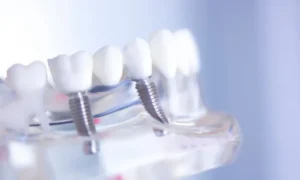
What’s a Dental Bridge?
A bridge does exactly what it sounds like. It fills the gap by creating a “bridge” between the teeth on either side.
Dr. Huckin prepares the two teeth next to the gap. He shaves them down a bit so they can act like anchors. Then he connects a false tooth between two crowns and cements the whole thing over those anchors. The false tooth sits right where your missing tooth used to be.
You don’t take it out. It’s fixed in place. It looks natural and works like a normal tooth.
The process takes a couple of visits. It’s fairly straightforward.
What’s a Dental Implant?
An implant is a different beast entirely.
Instead of relying on neighboring teeth, an implant stands on its own. Dr. Huckin places a small titanium post directly into your jawbone. That post acts like an artificial root. Over the next few months, the bone actually fuses with the titanium. It becomes part of you.
Once that fusion is solid, we attach a custom-made crown on top. What you see is a tooth that looks and functions just like a natural one. What you don’t see is the post underneath doing all the heavy lifting.
The whole process takes longer. But the result is incredibly strong.
Which One Lasts Longer?
A well-made dental bridge typically lasts about 10 to 15 years. Sometimes longer if you take great care of it. Eventually, though, the cement can break down. The crowns can wear out. The teeth underneath can develop decay that wasn’t caught quickly enough.
A dental implant, on the other hand, can last 25 years or more. Some studies suggest they can last a lifetime with proper care. Once that post fuses with your bone, it’s there for the long haul. The crown on top might need replacing eventually, but the implant itself is built to stay.
Why Does an Implant Last So Much Longer?
It comes down to two things: the bone and the neighbors.
With a bridge, you’re asking two healthy teeth to do extra work. They weren’t designed to support a third tooth. That extra stress can wear them down over time. Plus, those anchor teeth are still susceptible to cavities and gum disease. If one of them fails, the whole bridge fails.
With an implant, you’re not touching the neighboring teeth at all. They stay perfectly healthy. The implant stimulates your jawbone just like a natural root would. That stimulation keeps your bone strong and prevents the bone loss that normally happens when a tooth goes missing.
So Why Would Anyone Choose a Bridge?
Bridges are faster. You can have one in place in just a couple of weeks. No surgery. No months of healing. If you need a quick fix, a bridge gets it done. Bridges are also less expensive upfront. Implants cost more initially because of the surgery and the custom fabrication.
And some people simply aren’t candidates for implants. If you’ve lost too much bone mass in your jaw, you might need a bone graft first. Not everyone wants to go through that.
What’s Best for You?
There’s no one-size-fits-all answer. If you want the longest-lasting solution and you’re willing to invest the time and money, an implant is hard to beat. If you prefer a quicker, more affordable fix and the teeth on either side are strong and healthy, a bridge might be the way to go.
Dr. Huckin has placed countless bridges and implants over the years. He can look at your situation and tell you straight which option makes sense for your mouth, your budget, and your goals.
The best choice is an informed choice. Come see us and we’ll walk you through it.