
You know what a filling is. You’ve probably had one or two yourself. The dentist drills out a little bit of decay, packs in some tooth-colored material, and you’re done. Easy. But sometimes a filling just won’t cut it. That’s where dental crowns come in.
Let’s talk about what crowns are, why you might need one, and what getting one actually feels like. Spoiler alert: it’s not nearly as bad as you might think.
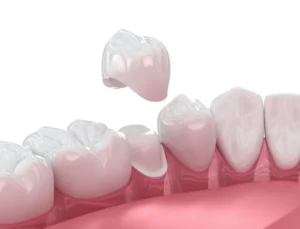
What Exactly Is a Dental Crown?
Think of a crown as a little helmet for your tooth. It covers the entire visible part of the tooth from the gum line up. Unlike a filling that only fills a hole, a crown surrounds the whole thing and holds everything together. We call it a crown because that’s exactly what it does. It sits on top of your tooth like a king or queen’s crown.
Crowns can be made from different materials. Some are all porcelain, which looks just like a natural tooth. Others are porcelain fused to metal for extra strength. Dr. Huckin helps each patient choose the right type based on where the tooth is and what kind of wear and tear it takes.
How Do You Know When a Filling Won’t Work?
Here are the situations where we stop reaching for a filling and start talking about a crown instead:
- There isn’t enough tooth left. A filling needs something to hold onto. If a tooth has a large cavity or an old filling that’s failing, there might not be enough solid tooth left to support a new filling. A crown can hold everything together when a filling simply can’t.
- Your tooth fractured. Not every chip means you lose the tooth. But some fractures go deep enough that a filling can’t seal them properly. A crown can wrap around the damage and stop it from spreading further.
- You just had a root canal. Back teeth that get root canals become brittle over time. They need a crown to protect them from cracking. Front teeth don’t always need crowns after root canals, but those molars? Definitely.
- Your tooth is badly worn or broken. Maybe you grind your teeth at night. Maybe you bit into something you shouldn’t have. Either way, if a tooth is worn down or broken in a big way, a crown can rebuild it.
What Does Getting a Crown Actually Feel Like?
Getting a crown usually takes two visits. At the first visit, we numb the area so you don’t feel a thing. Then we shape the tooth down a little bit to make room for the crown. We take some molds and put on a temporary crown. That temporary one is plastic and not as strong, but it gets you through the next couple of weeks.
You might feel some tenderness in your gums after the numbness wears off. That’s normal. It usually goes away in a day or two.
At the second visit, we take off the temporary and cement the permanent crown in place. That visit is quick. No needles. No numbness. Just a little adjusting to make sure the bite feels right.
How Long Do Crowns Last?
With good care, a crown can last 10 to 15 years, sometimes longer. Taking care of a crown doesn’t require anything special. You brush it and floss it. You come in for regular cleanings. That’s it.
Crowns won’t get cavities, but the tooth underneath still can. So don’t ignore it just because it’s covered. Keep it clean and it’ll serve you well for a long time.
Does Your Tooth Need a Crown?
If you’ve got a tooth that’s been bothering you, or if an old filling feels like it’s coming loose, come see us. We’ll take a look and tell you straight whether a crown makes sense.
Sometimes a filling is enough. Sometimes you need something stronger. Either way, we’ll get you sorted out.